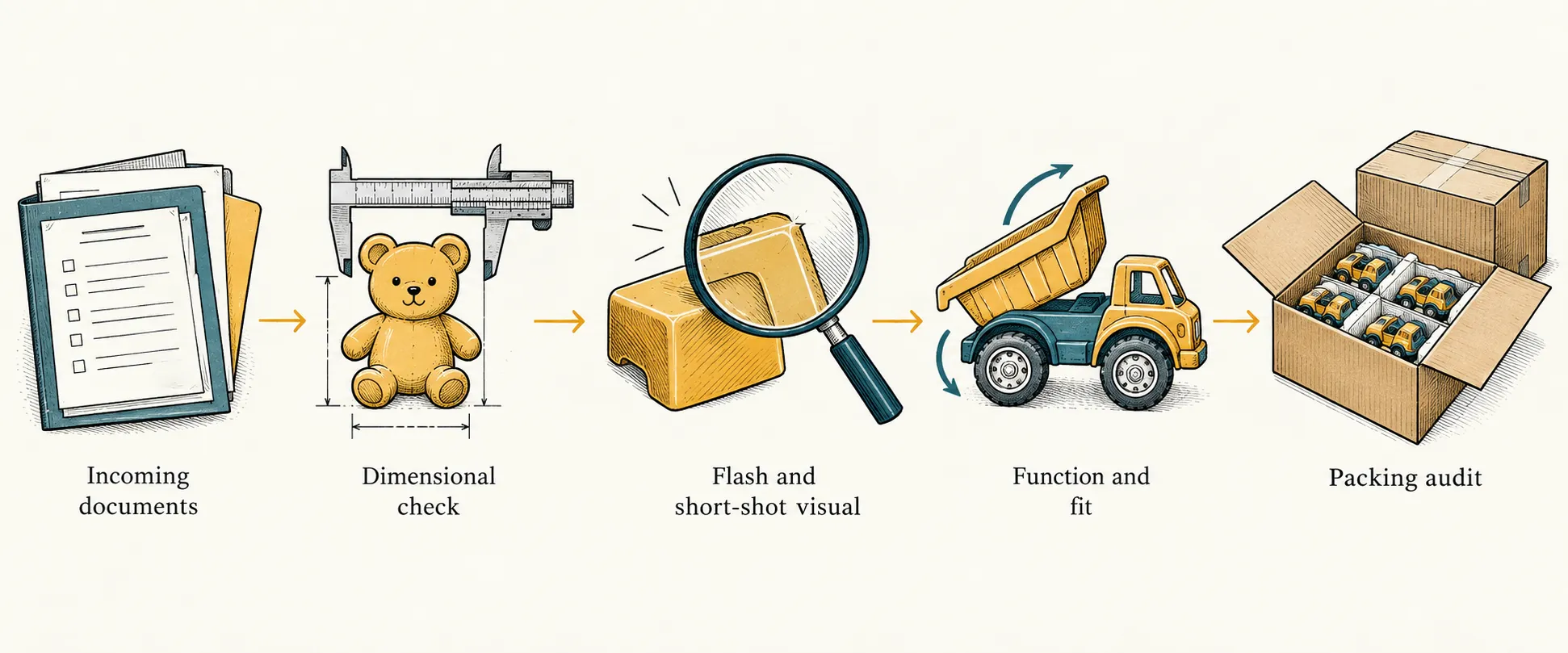
Import toys from China to the USA by approving the exact product and age grade before committing to production, then resolving testing, certification, packing, and entry arrangements before shipment. Use a milestone-based plan: SKU review, sample approval, applicable U.S. testing and CPC preparation, carton verification, broker review, freight booking, inspection, and receiving. Give each milestone an owner; the supplier, laboratory, broker, and forwarder handle different tasks, while the importer coordinates the shipment decision.
Run the work in parallel where practical, but do not confuse a freight reservation with approval to ship. A booking does not settle product safety, document accuracy, or whether the warehouse can receive the cargo.
What should the importer approve before placing the production order?
Approve a written product specification, a defensible intended age range, and a reference sample before authorizing production.
The supplier should identify the exact toy, included accessories, dimensions, materials and components, operating features, packaging, and proposed artwork. Flag batteries, magnets, projectiles, detachable pieces, and other features for the laboratory's applicability review. Photographs should show the contents of the retail pack—not just the main toy.
The importer should then compare the sample with the specification and intended use. Do not select an older age label simply to avoid evaluating a feature. Where the age grade is uncertain, resolve it with a qualified product-safety specialist before approving the package or test plan.
Retain an approved reference sample and revision-controlled specification. Ask the supplier to obtain written approval before changing components, construction, accessories, or artwork. That creates a usable comparison point for production inspection and later laboratory review.
Which U.S. toy-testing requirements should shape the purchase?
| Toys intended primarily for children 12 years old or younger | Third-party testing and a Children's Product Certificate apply to the applicable children's-product safety requirements, including 16 CFR part 1250. |
|---|---|
| Products intended for children under 3 years old | Must not contain small parts or release small parts after use-and-abuse testing. |
| ASTM F963-23 applicability date | CPSC identifies April 20, 2024, as the effective date for children's toys manufactured on or after that date. |
| Applicable sections of the toy standard | For toys manufactured overseas, the importer is responsible for identifying which sections apply to the product. |
How should the importer, supplier, and laboratory divide testing and CPC work?
Make the importer the owner of the applicability review and certification file, the supplier the source of accurate construction details and samples, and the laboratory the evaluator of the applicable tests.
Ask a CPSC-accepted laboratory to review the toy's intended age, construction, accessories, and operating features before finalizing the test scope. Not every ASTM F963 section requires third-party testing, and different toys do not automatically need identical test packages. CPSC Toy Safety FAQ
Give the laboratory production-representative samples and identify the specification revision they represent. Have the supplier disclose any differences between those samples and the planned production. A hand-finished sample is a poor reference if the shipment will use different components.
Keep laboratory reports and the CPC as separate records: the report documents testing, while the CPC certifies compliance with applicable requirements. Assign CPC preparation and review explicitly rather than treating a supplier's document bundle as automatically ready for use.
As a purchasing control, reconcile the product description, photographs, construction, tested requirements, and manufacturing information across the file. If a component or construction changes, have the laboratory evaluate the effect on test coverage. Do not assume that every new internal SKU needs a new test—or that an existing report covers every variation.
How should you compare an existing test report with a new test proposal?
Evaluate an existing report against the exact proposed construction and applicable requirements, not just the product name printed on its cover.
Consider two document packages for the same purchasing decision. One identifies a toy whose photographs, accessories, and construction match the proposed order. The other covers a similar-looking toy but shows a different accessory set. These are document-review scenarios, not claims about particular products.
For the matching package, ask the laboratory to assess whether its scope and underlying evidence support the planned product. For the different-accessory package, resolve the construction difference before relying on it; the accessory may change the applicable assessment.
The decision is therefore not 'old report versus new report.' Prefer evidence that demonstrably fits the product and applicable requirements. Commission additional evaluation where the laboratory identifies a coverage gap, rather than purchasing a generic test package by name alone.
What carton data should the supplier confirm before freight booking?
Obtain measured packed-carton dimensions, gross weight, carton count, and a SKU-level packing breakdown before accepting a freight quote.
Have the supplier prepare a packing summary showing units per inner pack and master carton, net and gross weights, external carton dimensions, total units, and carton marks. For mixed cartons, identify the quantity of each item inside. If the goods will be palletized, request the final pallet footprint, height, weight, and count as well.
Separate preliminary packing estimates from confirmed production measurements. Ask the forwarder to price the same packing configuration the supplier will actually ship; otherwise two freight quotes may describe different cargo.
Calculate carton volume using external dimensions in meters: length × width × height. Sum the volumes across carton sizes. Treat that as a planning input, not the final freight charge: ask the forwarder which chargeable basis and handling assumptions apply.
Before release, reconcile the packing list with the commercial invoice and physical carton count. An attractive unit price is not a substitute for knowing what will arrive at the dock.
What should the customs broker resolve before cargo leaves China?
Give the broker the product and transaction details early enough to confirm the proposed entry approach before departure.
Send a clear product description, photographs, intended age, construction and operating details, country of manufacture, invoice draft, packing summary, and available safety-document references. A description such as 'plastic toys' gives the broker little basis for reviewing the entry.
Request written answers to these shipment-specific questions: What U.S. tariff classification is proposed, and why? What duties, additional tariffs, fees, and bond arrangements apply to this transaction? Which invoice details and origin markings should be checked? What certificate-data submission or other filing arrangements apply at the expected entry date?
For an ocean shipment, ask who will handle Importer Security Filing, what information they need, and what filing cutoff must be met before loading. Obtain the confirmed instructions rather than working backward from the vessel's arrival date.
Keep classification and entry questions with the broker, and product-test interpretation with the laboratory or product-safety adviser. These are different reviews. Neither a freight quote nor a supplier's general assurance completes both.
How should the importer choose freight and assign responsibilities?
Choose freight against a confirmed cargo-ready date, delivery requirement, packed dimensions, and written scope of charges—not a headline shipping price.
Request air and ocean options when the delivery decision is genuinely open. Choose air when the quoted schedule and total cost justify meeting a tighter receiving requirement. Choose ocean when its quoted schedule meets the receiving plan and the total cost is preferable. Neither decision should bypass product or document approval.
Have the supplier confirm the named delivery point and its responsibilities under the agreed trade term. Ask the forwarder to spell out origin pickup, export handling, main carriage, destination handling, storage exposure, and final delivery. Identify charges excluded from the quotation.
Assign the importer of record, customs broker, freight forwarder, and final receiving party by name in the shipment plan. A DDP, CIF, or FOB label does not itself demonstrate product-safety compliance.
Build the landed-cost worksheet from the purchase cost, testing and inspection, origin charges, freight, insurance, broker-confirmed duties and fees, destination handling, and inland delivery. Leave rate-sensitive items open until the responsible provider quotes them; do not fill the worksheet with assumed duty-free treatment.
What should inspection confirm before shipment release?
Use inspection to confirm that production matches the approved specification and packing plan; do not use it as a substitute for applicable safety testing.
Before production, agree on the reference sample, inspection scope, sampling approach, and acceptance criteria. Consider an in-production check when construction or assembly decisions would be difficult to correct after packing. Arrange the final inspection while there is still an opportunity to investigate and correct findings.
Direct the inspection toward observable purchase requirements: correct item and accessories, assembly and operation, visible workmanship, approved artwork, quantities, carton marks, measured weights and dimensions, and protective packing. Identify any proposed buyer screening checks as purchasing criteria, not compliance standards.
Require findings to reference photographs and the approved specification. For a discrepancy affecting construction, intended use, or possible test coverage, refer it to the appropriate technical reviewer rather than letting the inspector improvise a safety conclusion.
Release cargo only after inspection findings are resolved or expressly accepted through a documented decision, and after the separate product-compliance and shipping-document reviews are complete.
How should the importer plan arrival and warehouse receiving?
Plan backward from the warehouse receiving requirement, with separate milestones for production readiness, shipment release, departure, entry coordination, and delivery.
At order placement, assign an owner and completion condition to each milestone. The supplier owns production and packing updates; the laboratory reports on its evaluation; the broker confirms entry instructions; the forwarder updates transport arrangements; and the importer decides whether the shipment is ready to move. Set actual dates using confirmed schedules rather than a universal lead-time allowance.
Before departure, send the agreed document set to the broker and forwarder and obtain acknowledgment. Confirm the receiving address, appointment process, unloading capability, pallet or carton requirements, and delivery contact. Ask how schedule changes, examination, storage, or missed delivery appointments would be handled and charged.
At receipt, count cartons, photograph visible damage, compare carton marks with the packing list, and record shortages or discrepancies before stock is released internally. Keep the order, specification revision, test and certification records, inspection report, and shipment documents connected to the received goods.
The practical release rule is simple: move the shipment when the product, documents, cargo measurements, and receiving arrangements agree—not merely when the factory says the goods are ready.