Approve each imported toy SKU against three separate checks: its applicable requirements, its supporting test evidence, and its Children’s Product Certificate (CPC). CPSC says toys primarily intended for children 12 years of age or younger require third-party testing and CPC certification for applicable children’s product safety rules, subject to applicable testing exemptions or determinations. Your practical task is to connect the exact toy construction to the required tests and certificate—not merely collect a document labeled “ASTM F963.”
Keep the test plan, laboratory report, and CPC distinct. The plan defines what needs evaluation; the report records the tested sample and results; the CPC certifies compliance with the applicable rules. CPSC’s guidance establishes the testing and certification framework. CPSC Toy Safety FAQ CPSC CPC Guidance
This checklist is a purchasing and document-review method for U.S. imports, not legal advice or a substitute for a product-specific compliance assessment.
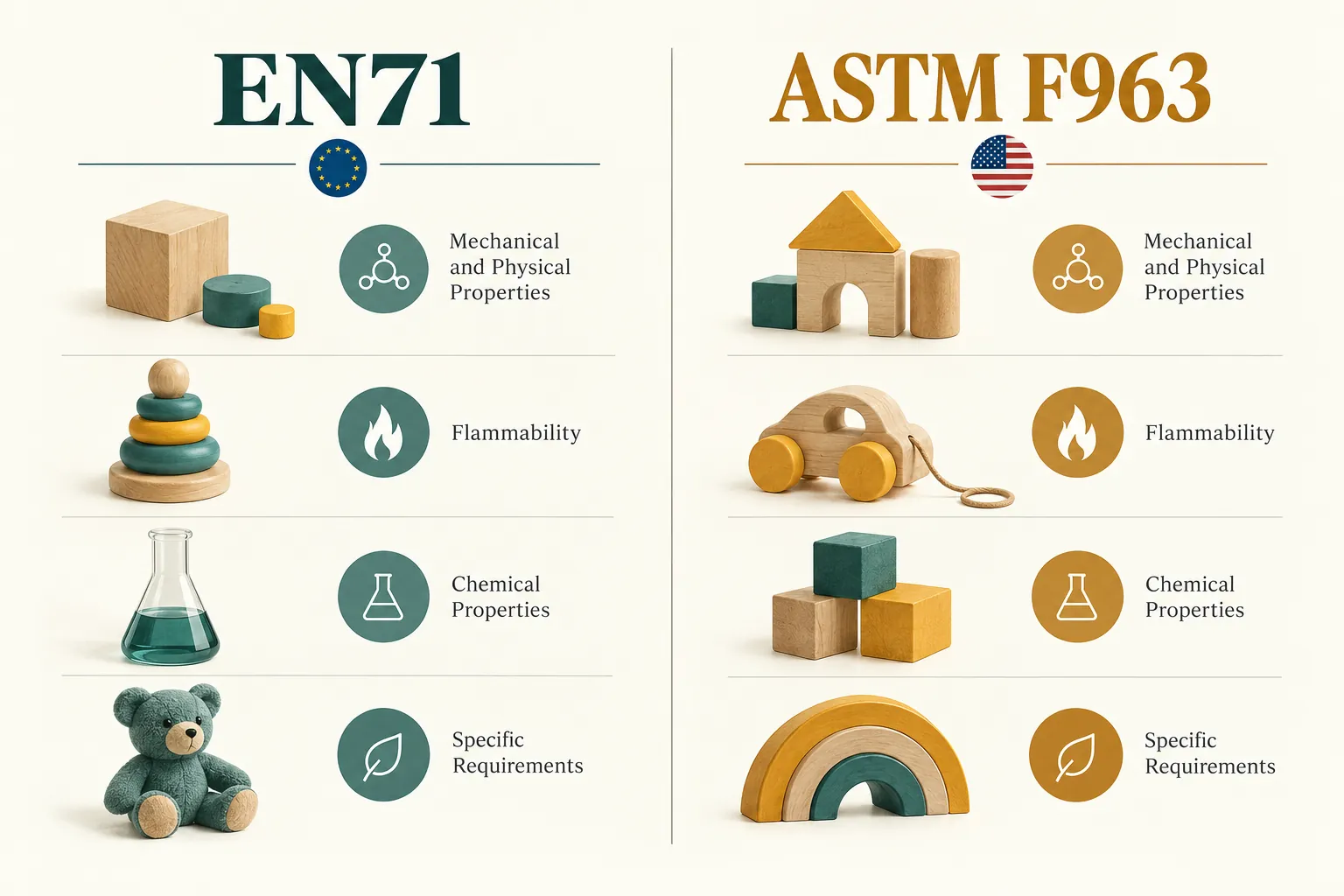
Which age scope and ASTM F963 edition belong in the SKU file?
Record the toy’s intended age group and manufacturing date before selecting its testing and certification requirements.
The third-party testing and CPC requirements discussed here apply to toys designed or intended primarily for children 12 years of age or younger, including age 12. ASTM F963 has a broader scope that includes toys intended for children under 14. A toy intended for a 13-year-old audience may therefore fall within ASTM F963 without requiring children’s-product third-party testing or a CPC. Do not treat those two age boundaries as interchangeable. CPSC Toy Safety Guidance
CPSC identifies April 20, 2024 as the effective date for ASTM F963-23, tied to toys manufactured on or after that date. Use the manufacturing date—not the purchase-order date—to check the applicable edition, and confirm the official requirements relevant to the production being purchased. That effective date is not a new annual certificate-renewal deadline. CPSC Toy Safety FAQ
How should the importer build a SKU-specific test plan?
Build the test plan by mapping the toy’s characteristics to applicable requirements, then identifying which provisions require CPSC-accepted third-party testing.
CPSC assigns the domestic manufacturer or importer responsibility for identifying the toy-standard sections that apply. Not every ASTM F963 section applies to every toy, so a generic instruction to “test to ASTM F963” is not a complete applicability decision. CPSC Toy Safety FAQ CPSC Toy Safety Guidance
As a practical purchasing control, maintain a requirements matrix with the SKU identifier, intended age, construction description, applicable rule and section, evaluation method, and supporting report or other evidence. Record why a provision is applicable or excluded. Have the laboratory review the proposed scope, but retain the importer’s applicability decision in the file.
Separate applicability from laboratory testing. CPSC lists the ASTM F963 provisions requiring testing by a CPSC-accepted third-party laboratory; referenced labeling and instructional-labeling requirements are excluded from that testing list. Review applicable labels and instructions separately rather than assuming a laboratory pass covers them. CPSC Toy Safety FAQ
What should the importer check in the laboratory report?
Accept a report as supporting evidence only after checking that its laboratory, tested sample, and test scope match the requirements being certified.
For provisions requiring third-party testing, verify that the laboratory is CPSC-accepted for the relevant testing scope. A supplier’s overseas location neither validates nor invalidates its report; the useful checks are the laboratory’s acceptance and the report’s relevance to the toy. CPSC Toy Safety FAQ
Match the report’s sample description, photographs, model references, materials, colors, and components against the ordered construction. Ask for a documented cross-reference where the supplier’s model name differs from your internal SKU. A matching product name alone is a weak identification control.
Then reconcile the tested provisions against your requirements matrix. Check the standard edition, test dates, results, and any exclusions or qualifications. Treat these as document-review steps, not additional safety tests. A report for a development sample does not automatically establish coverage of a later production lot with different construction.
Who handles the CPC, and how should the rules be cited?
For an imported toy, keep the importer’s certification responsibility separate from the laboratory’s testing work: the test report supports the CPC but does not replace it.
Use the importer as the certifying firm for the imported product, and reconcile the certificate with the SKU’s requirements matrix and supporting evidence. A factory-prepared draft can assist the review; do not treat the document’s title or formatting as proof that the importer’s certification task is complete. CPSC CPC Guidance
For children’s toys, CPSC instructs certifiers to use “16 C.F.R. part 1250 – Children’s toys” in the CPC’s rule-citation element, followed by the applicable ASTM F963 sections. Do not substitute a bare “ASTM F963” statement for this citation. Add other applicable children’s product safety rules using their appropriate legal citations rather than assuming the toy-standard citation covers everything. CPSC Toy Safety Guidance
Which seven elements must the CPC contain?
| 1. Product identification | Identification of the product covered by the certificate. |
|---|---|
| 2. Applicable rule citations | Each applicable children’s product safety rule for which compliance is certified. |
| 3. Certifying firm | Identification of the importer or domestic manufacturer certifying compliance. |
| 4. Records contact | Contact information for the person maintaining the supporting test records. |
| 5. Manufacturing information | The date and place where the product was manufactured. |
| 6. Testing information | The date and place where the product was tested. |
| 7. Laboratory identification | Identification of the CPSC-accepted third-party laboratory whose testing supports the certification, subject to applicable testing exemptions or exceptions. |
What changes when a testing exemption applies?
An applicable testing exemption or CPSC determination can remove a testing obligation without removing the CPC obligation.
CPSC says manufacturers and importers must still issue a CPC citing the applicable regulations and identify the exemption or exception claimed instead of a third-party laboratory for products that were not tested under that relief. Keep the explanation specific to the requirement receiving relief; do not turn a limited testing exemption into a blanket statement that the toy needs no certification. CPSC CPC Guidance
How should buyers compare coverage across multiple SKUs?
Review coverage SKU by SKU, but do not assume that every internal SKU automatically requires a separate test report.
Consider two document packages. One contains a passing report and a CPC, but neither clearly connects the tested model to the ordered variants. Hold compliance sign-off until that connection is resolved. The other includes a model cross-reference, a construction comparison, a provision-by-provision evidence map, and a CPC identifying the covered products and applicable rules. That package gives the reviewer a traceable basis for evaluating coverage; it still requires substantive review.
For variants differing in color, components, or materials, request a written coverage assessment explaining how the evidence applies to each construction. Neither a shared product name nor a new internal SKU number settles that question. If construction changes, reopen the coverage assessment rather than assuming the earlier report remains sufficient.
Use a simple internal release gate: the ordered toy is identifiable, its applicable requirements are mapped, the supporting evidence addresses those requirements, and the CPC’s seven elements reconcile with the file. This is a recommended purchasing control—not a guarantee of compliance or customs clearance.